
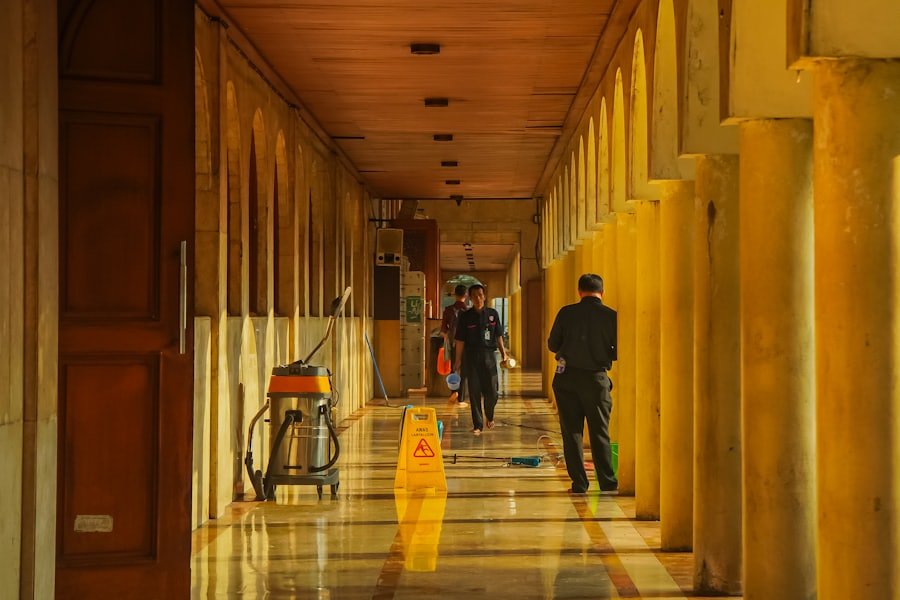
Housekeeping is the service residents judge you on every single morning. It is also the one most often staffed thinly and supervised loosely. We run it on a published schedule, with named staff, a supervisor on site and an attendance record the association can inspect at any time.
A residential community is not an office floor. Corridors take footfall from 5am to midnight, basements collect dust and oil, staircases are used as shortcuts, and the clubhouse turns over completely on weekends. Cleaning all of that on one uniform schedule produces the familiar result: spotless entrance lobby, neglected fire staircase. We map each community block by block and assign frequencies that match how each area is actually used — twice-daily on high-traffic lobbies and lift cars, daily on corridors and staircases, weekly on basements and terraces, and a deep-clean cycle on a rolling calendar.
Staffing is where most contracts quietly fail. Our teams are recruited on roll, not sourced per shift, which is what makes consistency possible — the same faces, week after week, who know that the third-floor corridor gets treated after the school run and that the party hall needs turning around by Sunday morning. Every team works under a site supervisor who signs the daily checklist, and attendance is recorded and shared, so a shortfall is visible to the association the same day rather than at the end of the month.
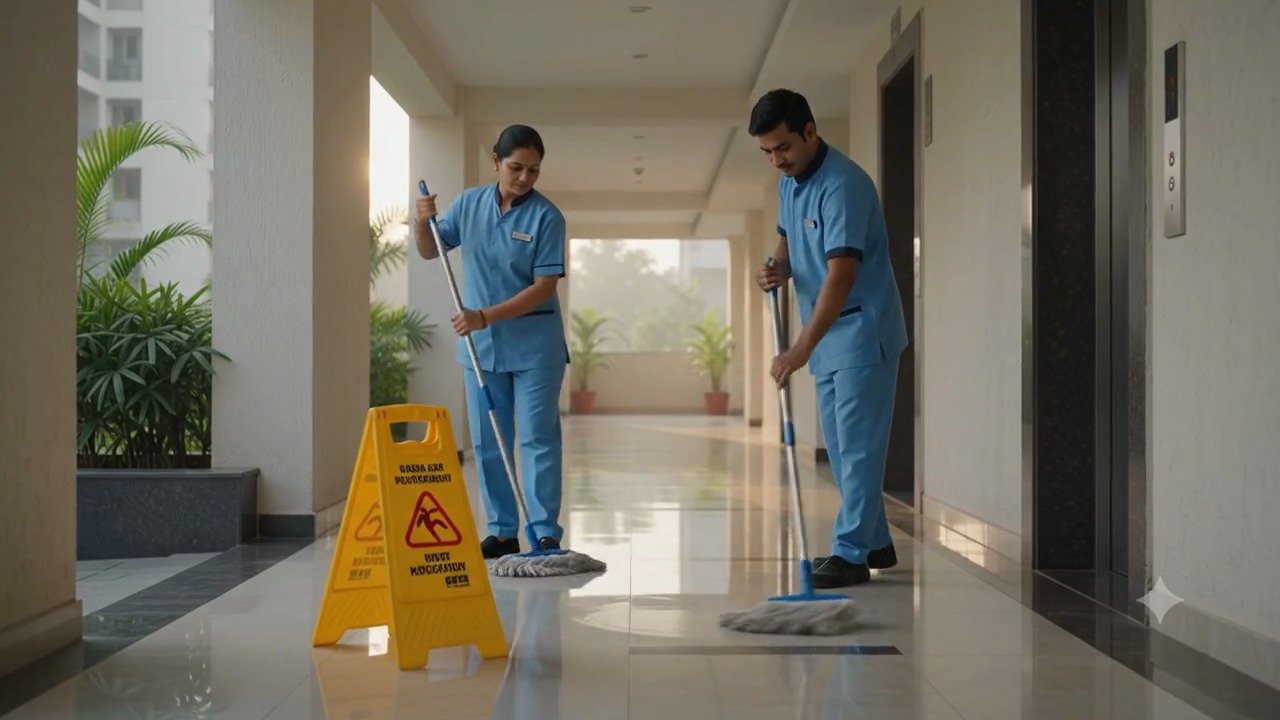
Staffing is where most contracts quietly fail.
Materials matter as much as manpower. We standardise on colour-coded microfibre to keep washroom cloths away from dining and lobby surfaces, use pH-appropriate cleaners for granite, vitrified tile and natural stone so floors are not stripped of finish over time, and match machines to the surface rather than scrubbing everything with the same pad. Consumables in common washrooms are tracked and replenished on a par level, not on complaint.
Waste handling is included and treated as a discipline in its own right: segregated collection from floors, correct staging at the collection point, and coordination with the municipal or private lifting schedule so bins are never the first thing a visitor sees. Where a community is running wet-waste composting or is working towards its own segregation compliance, we align the housekeeping routine to support it rather than undo it.
How we run it
- 01
Site mapping
We walk every block and record areas, surfaces, footfall and problem points before quoting a headcount.
- 02
Published schedule
Each area gets a frequency and a time slot. The schedule is displayed on site so residents know what happens when.
- 03
Daily supervision
A site supervisor signs off the checklist each shift and logs attendance, escalations and consumable usage.
- 04
Monthly review
A written report to the association covering attendance, complaints raised and closed, and consumption.